For global buyers, choosing a Rigid Pallet Box involves more than comparing prices. The right supplier must combine structural strength, hygienic design, dimensional accuracy, and dependable international service. A damaged box can disrupt a production line, delay a shipment, or expose weaknesses in warehouse handling. Small details matter, including reinforced corners, smooth internal walls, drainage options, and forklift entry points.
Dr. Jay Singh, a recognized packaging and logistics researcher, offers a useful principle: “Packaging must protect the product while fitting the realities of distribution.” That principle is especially relevant when evaluating the 2026 leading Rigid Pallet Box manufacturers. Buyers should examine material consistency, load performance, nesting efficiency, repair support, and documented quality controls. Recycled content may also matter, but it should not replace verified durability. Sustainability claims need evidence.
The manufacturers featured in this guide are assessed through practical buyer criteria. These include production capability, export experience, customization, lead times, and after-sales responsiveness. Factory audits, sample testing, and real handling trials remain valuable. Specifications alone can mislead. A box that performs well in a laboratory may behave differently on a crowded loading dock, under rain, dust, or repeated impacts.
There is no perfect supplier.
Budget pressure can distort good decisions. Buyers may overlook replacement rates, storage space, or inconsistent dimensions. This guide therefore encourages careful comparison, not automatic trust. The strongest Rigid Pallet Box partner is the manufacturer that delivers measurable performance repeatedly, across different markets and demanding supply-chain conditions.
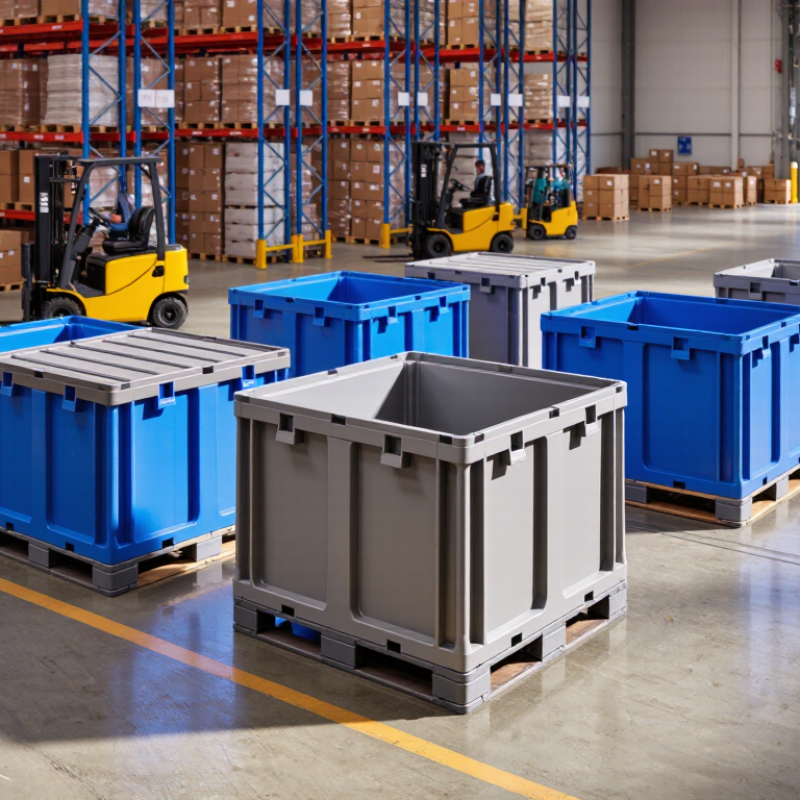
Rigid pallet boxes are reusable bulk containers built with fixed walls, a pallet base, and reinforced corners. Unlike collapsible bins, they keep their shape under repeated handling and stacking. In warehouse inspections, I often see them used for components, produce, chemicals, and other regulated goods. Their enclosed design reduces crushing, dust exposure, and shifting during forklift movement.
Global buyers choose rigid pallet boxes because they improve load stability and warehouse efficiency. A correctly sized box can hold more units while using fewer layers of stretch film. Smooth interior surfaces also make cleaning easier between production cycles. Many models include drain holes, access doors, or label panels for faster identification. Small details matter.
Check the load rating carefully.
A strong box is not automatically suitable for every supply chain. Buyers should compare internal dimensions, nesting ability, pallet compatibility, and resistance to temperature changes. Empty return freight can become expensive when boxes cannot nest. That issue is easy to overlook. Reliable purchasing also requires clear test reports, material information, inspection records, and traceable production data. In my experience, suppliers sometimes describe capacity generously, while actual performance depends on load distribution and stacking height. A pilot shipment is wiser than trusting a brochure alone.
In 2026, evaluating rigid pallet box manufacturers requires more than comparing unit prices. The World Bank’s What a Waste 2.0 report projects global waste to reach 3.40 billion tonnes annually by 2050, up from 2.01 billion tonnes in 2016. Reusable boxes can support waste reduction, but only when they survive repeated handling. Ask manufacturers for cycle-test records, impact results, repair rates, and documented material specifications.
In 2026, evaluating rigid pallet box manufacturers requires more than comparing unit prices. The World Bank’s What a Waste 2.0 report projects global waste to reach 3.40 billion tonnes annually by 2050, up from 2.01 billion tonnes in 2016.
Check whether each box matches your actual warehouse conditions. Measure pallet footprints, forklift clearance, stacking height, drainage needs, and empty-box storage space. A reliable manufacturer should provide load ratings based on recognized testing methods, such as ISO 8611, rather than marketing estimates. Review resin traceability, ultraviolet resistance, hinge performance, and lid replacement procedures. Small design details matter. A weak corner can stop a full export shipment.
Review resin traceability, ultraviolet resistance, hinge performance, and lid replacement procedures. Small design details matter. A weak corner can stop a full export shipment.
Cost analysis should include freight, cleaning, repairs, loss, and expected service life. The Ellen MacArthur Foundation has repeatedly highlighted reuse as a major pathway for reducing packaging waste, but reuse systems require reverse logistics and disciplined tracking. No checklist is perfect. Forecasts may assume ideal return rates, while real operations often lose containers. Request pilot quantities, inspect samples after actual warehouse cycles, and compare performance across seasons before signing a long-term contract.
For international purchasing in 2026, leading rigid pallet box manufacturers must offer more than large production lines. Experienced buyers examine material consistency, mold accuracy, and documented load performance. A suitable box should match pallet footprints, forklift access, stacking height, and warehouse temperature. High-density polyethylene models resist moisture and repeated washing, while reinforced designs support heavier industrial loads. Ask for test reports based on recognized packaging standards. Request recent production photos, not only polished catalog images. Small details matter: lid fit, drain holes, label areas, and rounded corners affect daily handling.
Reliable manufacturers communicate clearly across borders. They confirm minimum order quantities, tooling ownership, lead times, export packaging, and replacement policies before payment. They should explain how batches are inspected and how defects are recorded. A factory audit, video inspection, or pre-shipment sample can reveal weak hinges and uneven walls. Still, no supplier is flawless. A sample may not represent every batch, especially during peak production. Build acceptance criteria into the purchase contract, including dimensions, color tolerance, load limits, and inspection rights. This protects budgets without creating unrealistic promises.
Tips: Compare at least three manufacturers using the same specification sheet. Measure an empty box and a loaded box. Check stacking stability on a slightly uneven floor. Ask whether replacement parts remain available after several years. Confirm customs documents and palletization details early. Keep written records of approvals. It feels slow, but rushed sourcing often costs more.
2026 Top Rigid Pallet Box Manufacturers for Global Buyers
Comparing rigid pallet box manufacturers requires more than checking the unit price. Request pricing for the same volume, lid design, load rating, and delivery term. A low quote may exclude tooling, export packing, or replacement parts. The World Bank’s 2023 Logistics Performance Index evaluates customs, infrastructure, tracking, and timeliness. These factors directly affect landed cost and production continuity.
Certifications should match the cargo and destination. ISO 9001 supports process consistency, but it does not prove product performance. Ask for test reports covering compression, stacking, impact resistance, and temperature exposure. ISO 6780 provides a useful reference for pallet dimensions. Food-contact applications may require additional regional compliance evidence. Certification documents can look impressive. Traceability matters more. Manufacturers should identify production dates, materials, and inspection methods.
Tips: Compare total cost of ownership, not price alone. Measure return rates, repair time, nesting efficiency, and container utilization. Ask for a sample under realistic loading conditions. Check whether spare lids and hinges remain available after purchase. The supplier’s promised lead time should include molding, inspection, customs, and inland delivery. This is often overlooked. Also, request written after-sales procedures, response targets, and escalation contacts. In practice, buyers sometimes overvalue certificates and undervalue communication. That judgment deserves another review.
Practical comparison framework using recognized international standards, common pallet formats, and buyer-verification checkpoints. All commercial figures should be confirmed in a written quotation.
| Comparison Dimension | Common Market Reference | What Buyers Should Compare | Required Evidence | Commercial Impact |
|---|---|---|---|---|
| Primary Material | HDPE or PP rigid plastic; virgin, recycled, or mixed resin options | Impact resistance, stiffness, chemical resistance, cleanability, recycled content, and material traceability | Material declaration, resin grade, technical data sheet, and sample inspection | Material grade and recycled-content percentage can materially change durability and unit cost |
| External Footprint | ISO pallet: 1,200 × 1,000 mm; Euro pallet: 1,200 × 800 mm; North American pallet: 1,219 × 1,016 mm | Compatibility with racking, conveyors, trucks, containers, and existing pallet positions | Dimensioned drawing, tolerance table, and fit test with the buyer’s handling equipment | A non-standard footprint may increase transport cost and reduce warehouse density |
| Load Performance | Static, dynamic, and racking loads vary by design, temperature, stacking height, and use cycle | Compare the same test method, load direction, safety factor, and service conditions | Load-test report, test date, sample configuration, and laboratory or internal test method | Higher load ratings may require thicker walls, reinforced feet, or additional ribs |
| Box Capacity | Common usable volumes range from approximately 200 to 1,000 litres, depending on footprint and height | Internal volume, usable fill height, wall taper, lid clearance, and compatibility with liners or bags | Internal and external dimensions, calibrated volume measurement, and product drawings | Larger usable volume can reduce handling units but may increase empty weight and freight cost |
| Nesting and Stacking | Nesting reduces empty-return volume; stackable designs require stable locating features | Empty nesting ratio, loaded stack height, lid strength, anti-slip features, and stability during transport | Stacking diagram, nesting ratio, vibration test, and approved operating instructions | Better nesting can reduce return freight and warehouse space requirements |
| Temperature Range | Performance depends on resin, wall thickness, impact speed, and application; no universal range applies to every box | Cold-impact performance, heat exposure, freezer use, UV exposure, and repeated thermal cycling | Material specification and application-specific temperature test results | Special low-temperature or UV-stabilized grades may increase price |
| Food and Pharmaceutical Use | Food-contact suitability must be assessed for the destination market and intended contents | Virgin resin, additives, colorants, cleaning process, migration limits, and traceability | Applicable food-contact declaration, migration testing, batch traceability, and cleaning validation documents | Compliance documentation and controlled production may increase qualification time |
| Quality Management | ISO 9001 is a quality-management-system standard; certification does not by itself certify product performance | Process controls, incoming-material checks, dimensional inspection, corrective action, and lot traceability | Valid certificate, certification scope, audit body, inspection plan, and sample records | Stronger quality controls can reduce defect, replacement, and line-stop risks |
| Export Compliance | Plastic packaging is generally not subject to ISPM 15; solid-wood pallets, crates, or dunnage may be subject to it | Packaging materials, timber components, country-specific import rules, and required shipping documents | Packing list, commercial invoice, origin documents, timber-treatment evidence where applicable, and customs classification support | Correct export packaging helps prevent customs delays, repacking, and storage charges |
| Unit Price Comparison | Prices vary with size, resin, tooling, lid, color, order quantity, and delivery terms | Compare like-for-like specification on an EXW, FOB, CIF, or DDP basis—not unit price alone | Formal quotation showing tooling, packaging, inspection, freight assumptions, taxes, and validity period | The lowest unit price may have higher tooling, freight, defect, or replacement costs |
| Tooling and Customization | Custom molds may be required for non-standard dimensions, logos, lids, drainage, or internal partitions | Tool ownership, modification rights, maintenance responsibility, mold life, and approval samples | Tooling agreement, drawing approval, first-article report, and ownership terms | Tooling charges and minimum order quantities affect total project cost |
| Production Lead Time | Standard products usually have shorter lead times than new molds or heavily customized products | Sample timing, tooling timing, mass-production timing, capacity reservation, and peak-season planning | Milestone schedule, production capacity statement, and shipment-readiness definition | A reliable schedule can be more valuable than a small price difference for seasonal demand |
| Container and Freight Efficiency | Rigid boxes are often shipped nested when the design permits; actual utilization depends on dimensions and packing method | Units per pallet, pallets per container, cubic utilization, gross weight, and damage protection | Load plan, packing photos, carton or pallet dimensions, and verified shipping weight | Improved cube utilization can reduce freight cost per usable litre |
| Inspection and Acceptance | Common checks include dimensions, appearance, weight, function, load performance, and quantity | Acceptance limits, sampling level, defect classification, inspection timing, and responsibility for third-party inspection | Approved quality standard, inspection checklist, pre-shipment report, and retained samples | Clear acceptance criteria reduce disputes and prevent unsuitable goods from shipping |
| Warranty and Claims | Warranty duration and exclusions are contract-specific; misuse, overloading, and unauthorized modification are commonly excluded | Coverage period, response time, evidence requirements, replacement policy, freight responsibility, and remedy options | Signed warranty terms, claim form, escalation contacts, and corrective-action procedure | Transparent claims handling lowers downtime and total ownership cost |
| After-Sales Support | Support quality should be measured by response and resolution performance rather than promotional claims | Named contact, technical documentation, spare-part availability, replacement lead time, and multilingual communication | Service-level agreement, support workflow, escalation matrix, and documented case records | Fast technical support is especially important for automated warehouses and returnable fleets |
| Sustainability and End-of-Life | Rigid plastic boxes can be reusable and recyclable, but recyclability depends on material composition, additives, contamination, and local infrastructure | Expected reuse cycles, repairability, recycled content, take-back options, mono-material design, and end-of-life route | Material identification, recycled-content statement, life-cycle data where available, and recycling guidance | Long service life and return logistics may provide greater savings than recycled content alone |
It is a reusable bulk container with fixed walls, a pallet base, and reinforced corners. It keeps its shape. The enclosed design protects goods from crushing, dust, and movement during forklift handling.
They improve load stability and warehouse efficiency. A suitable box can hold more units with less stretch film. Smooth interiors also make cleaning between production cycles easier.
Check drain holes, access doors, label panels, hinges, lids, and corner strength. Measure internal dimensions and forklift clearance carefully. Small details matter.
Ask for test reports covering compression, stacking, impact, and temperature exposure. Capacity depends on load distribution and stacking height. A strong box is not automatically suitable.
Request material specifications, production records, inspection results, and traceable batch information. Also ask about ultraviolet resistance and repair procedures. Traceability matters more than attractive documents.
Include purchase price, freight, cleaning, repairs, losses, and expected service life. Empty return freight can become expensive when boxes cannot nest. That part is easy to miss.
A pilot shipment tests real loading, handling, storage, and return conditions. Inspect the boxes after warehouse cycles and seasonal changes. I would not trust a brochure alone.
Confirm lead times for production, inspection, customs, and inland delivery. Ask whether replacement lids and hinges remain available. Written response targets can prevent confusion, though they may not solve everything.
Rigid Pallet Box is a durable, reusable bulk-handling solution designed to protect goods during storage, transportation, and international distribution. Global buyers value these boxes for their strong load-bearing performance, stackability, hygiene, and ability to reduce packaging waste. When evaluating manufacturers in 2026, purchasers should consider production capacity, quality control, export experience, product consistency, and responsiveness to custom requirements.
Important assessment factors include material selection, structural design, dimensions, ventilation, lids, access doors, labeling, and compatibility with automated handling systems. Buyers should also review manufacturing standards, testing procedures, certifications, lead times, shipping arrangements, and after-sales support. A reliable comparison should examine total cost rather than unit price alone, including customization, packaging, freight, import requirements, maintenance, and replacement expenses. By balancing product quality, compliance, logistics capability, communication, and long-term service, international purchasers can select a suitable supplier and achieve dependable performance across different supply chains.

Huiyuan Plastic